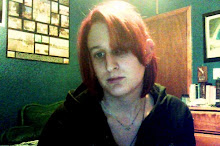
Saturday, June 27, 2009

M v. F

Daytime television is simultaneously the best and worst place to learn about gender expectations and the “true” meanings of masculinity and femininity. Take for instance that horrible half hour of Tim Allen-inspired comedy, “Home Improvement.” Today’s episode involved Tim essentially taking away his wife’s voice and choice—wanting her to forget about her school—her aspirations—to attend a dinner/bowling meeting with his boss; he wanted her to not discuss her life, to even intentionally lose the bowling game, all to advance his career. Along the way, Tim justifies this silencing gender politics saying his wife’s cooperation would help build the “Tim Taylor Empire,” and “every empire needs an empress.” The show is just full of these gross assumptions of the superiority of masculinity: the male is supposed to be all power and awesomeness—all the money and tools belong to the man, the man has a career while the woman has childcare, house work, and hobbies. Then man is intelligent, the woman is emotional. A kick in the balls trumps the pain of childbirth—and it is a contest. Yesterday on another show (some sort of wife-swap deal) I saw a woman lecturing a man, saying, “All the girls will do house work while the boys go out and build a step stool” In other words, the girls are maids, the boys get to play all day. She also said, “As a man you’re supposed to make the decisions.”

As a feminist, I’m finding daytime television to be an act of masochism; however, the depictions of women raise interesting questions about the nature of masculinity and femininity. I’ve been having a tough time with this issue of femininity—after all, googling the dichotomy of masculine and feminine is disparaging (and yes, I’m well aware the two are not, in reality, opposing sides of a dichotomous relationship. That said, given the society I live in, a society in which they are mutually exclusive forces, this is the system I am forced to operate within). Feminine is defined as opposing masculine, and masculine is defined as all qualities our patriarchal society deems awesome and strong. Femininity, by contrast, it weak and dull. But this is more a symptom of sexism defining the terms than a reality of an inherently pathetic feminine nature, right? Osho sure as hell thinks so:

It is the long condemnation of feminine qualities that has gone deep into the blood and the bones of women. It is man's conspiracy to prove himself superior to women -- which he is not.
And to prove that the woman is weak, he has to condemn all the feminine qualities. He has to say that they are all weak, and all those qualities together make the woman weak. In fact, the woman has all the great qualities in her. And whenever a man becomes awakened, he attains to the same qualities which he has been condemning in women. The qualities that are thought to be weak are all the feminine qualities. And it is a strange fact that all the great qualities come into that category. What is left are only the brutal qualities, animal qualities.
Love, trust, beauty, sincerity, truthfulness, authenticity -- these are all feminine qualities, and they are far greater than any qualities that man has. But the whole past has been dominated by man and his qualities.
Osho, excerpted from Sermons in Stones, Chapter 17

Part of me agrees with what Osho is doing on some level—certainly there’s a lot of strength and a lot of admirable qualities that are feminine; the problem, however, is that Osho moved to the polar opposite end of the pendulum swing, denigrating masculinity in the promotion of femininity. It’s an old Second-Waver tactic I’ve come to dislike. It seems more reasonable and accurate to simply suggest that a misogyny-driven disparity is more of a sociological assignment of different meanings, symbolisms and connotations between masculine and feminine. Moreover, though, the more I try to untangle what sorts of personalities and what sorts of expressions are which, the more the categories of masculine and feminine seem completely arbitrary.

It’s like when I try to guess what race any given person is; I know that racial qualifications are so blurred together that I cannot clearly distinguish one from another, and this is a sign of how heavily social construction plays on racial categorization. It’s certainly not so blatant with gender expression—as there are biological factors that influence womanly vs. manly traits—but the value assignment of traits is socially determined. But wait. Isn’t this entire discussion of masculine vs. feminine somewhat idiotic—basing an argument that assumes the two are in opposition is a terribly limited conversation. It’s self evident that given the current restrictions it is impossible to feel particularly inspired about femininity when it is so easily downplayed. Let’s face it, feminine qualities are not particularly respected in a patriarchy.

But qualifying anything aside from secondary body characteristics as masculine or feminine (to me) seems like a lost cause. I may feel like wisdom, cunning and intelligence are feminine traits—but my feeling that way, regardless of whether or not I can support the claim, is irrelevant: society has already decided what fits where. These allocations are all somewhat meaningless, though, as gender is not a binary and anyone, regardless of sex, can express assertiveness to gentleness without “compromising” their gender. Take for instance a woman who uses wisdom (a masculine trait) to console a depressed friend (a feminine trait); femininity can be manifest in masculine ways and visa versa. The two are not counteractive, but instead they are complimentary. When I get down to it, masculinity and femininity are so closely blended, I cannot tell the difference anymore.

Monday, June 15, 2009

All the difference

I guess you could call this my “guilty pleasure” edition of the Trans Configuration—though the term, “guilty pleasure” doesn’t seem sufficient or entirely appropriate to describe what I’m going to share with you today. This is an email featured on the Post Secret website (http://postsecret.blogspot.com/):

Tonight I was at Artomatic. On the metro ride home, there was a girl - quite beautiful - with dyed hair and heavy eye makeup but not enough to cover up that something was the matter. She was eying her wrists then looking around. I wish I knew her story. I wish I could help. So on a card I wrote
‘Dear Friend, though this is cliché, it has helped me to think the night is darkest just before the dawn.’
As she was getting off the metro she dropped a little PRIDE flag and as I picked it up, handed it to her and said, "I think you dropped something." I handed her the card.

I’m choosing to assume that the author of this email was NOT a presumptuous asshole; instead, I like to believe the situation was exactly as he presumed. If, indeed, this girl was thinking what she appeared to be thinking, then this single act restores a lot of my faith in humanity. It’s not something I’m proud of, but I was suicidal for the majority of the last three years. I used to cut my arms—the scars are now covered with a gorgeous tattoo—and I remember, now, all the people who made those years livable. My eyes started tearing up when I read this email, remembering how much like this girl I was.

It’s something I should probably do a blog post about: this fall into depression, self injury, suicide, etc. that can often accompany transitioning. It’s not something many people talk about, and maybe that’s because it’s not something everyone experiences; however, it’s an all-too common occurrence for those of us who transition without really trying to get all the psychological transitioning down. I don’t mean that to sound so pathological, but there’s a huge change that comes along with transitioning, and to transition without self acceptance and self love is very difficult (Granted, having been isolated in the Palouse didn’t help matters any). But I’m not going to delve into that right now. Instead, I’ll close with that image of a lost girl, eyeing her wrists, thinking how it will feel to drag her kitchen knife across her skin, and knowing that one sentence on one measly card could have made all the difference.

Wednesday, June 10, 2009

Facial feminization surgery and body modification politics

Author's note: I know the following essay tendrals a little bit; the arguments are not concrete and the supporting evidence is weak and random. This is probably the fourth time I've written this, and I can't seem to make it work out (probably because I've not been able to just write it all in one sitting). Anyway, I wanted to post it because I feel there are some interesting thoughts about FFS and body modification. Hope you enjoy.

The funny thing about body modification is how a personal decision becomes a political issue, one that often bridges a gap between the mainstream traditionalists (your Fox News types) and many in the feminist movement. The issue of body modification, at least on a macro-level, boils down into a conversation about what is deemed “natural” beauty ideals—the “traditional” attitude demanding a conservation of a natural beauty aesthetic as a non-augmented form, and the feminists speaking out against the oppression of women resulting from unnatural beauty standards. The two sides paradoxically clash while agreeing on this point: body modification is unnatural and unethical. But what of the motivations of those seeking to modify their bodies? Why should their decisions about their own bodies be distorted into a public discourse?

In a recent Associated Content article, Agnieszka Marczak writes, “The unadorned and unaltered body is constructed as the natural state and any willful changes wrought on its surface are by definition, cultural inscriptions. This makes sense from a Western perspective where the intellectual and philosophical traditions that support and inform these views come from the Greeks, who idolized the unadorned athletic body. As such, anything other than that ‘natural’ ideal was necessarily an unnatural modification.” Much of our body politics are derived from the notion that “natural” is a physical manifestation of God’s will—these are the way our bodies were meant to be, as was dictated by our creator, and any modification of these divine figures would be an affront to God. This is the more traditional/conservative perspective; the same attitude my parents and grandparents have when they criticize my tattoos and piercings. When I got my first tattoo my mother asked me, “Why did you do this to yourself? Couldn’t you just get a painting of this; why did you have to put it on your body?” There’s a sense that if people were “supposed” to have any given modification, God would have made them that way—there’s an implied divine design in the natural.

Coming from a feminist perspective, body modification has historically been a means of oppressing women; from corsets to foot binding, genital mutilation to modern “beautifying” plastic surgery, women’s body modification has been an integral component towards disempowering women. Not ironically, the pursuit of beauty is often contemporarily seen as futile, and beauty standards are classified as unnatural. It’s no wonder women body modifiers are frequently seen as outcasts; they at once subvert the beauty norm of the non-augmented body while simultaneously undermine the beauty of what a woman’s body is “supposed” to be.

Along the same vein, any unnatural or augmented expression can be distorted into disingenuous or otherwise fraudulent. That’s where the issue of transsexuality comes into play; transsexuals, in a very literal sense, typically undergo one of the most extreme forms of body modification: we literally modify sex—something that has, until recently, been assumed an immutable and intrinsic physical reality. Sex is supposed to be set in stone, and we subvert that very belief. We reform the body in ways that makes body suspension look like a harmless tea-time activity (which it very well may be). But transsexual body modification comes with its own unique form of scorn—labels of pathology are attached to each transformative procedure and even away from the psychological branding and the assertions from the religious right that transsexuality is a “destructive force” against humanity, trans women’s bodies are often viewed as parodies of “real” women; nothing but a façade of femininity. Thing is, though, trans people and their allies recognize that transition-based body modification is often a major part of living authentically (my note: some trans people don’t see any need for modification. Keep in mind, this article is about those who do modify). Indeed, the motivation behind transitioning is very similar—if not identical—to some of the reasons given for getting tattoos and piercings. According to Victoria Pitts, “Women body modifiers have argued that modifying the body promotes symbolic rebellion, resistance, and self-transformation—that marking and transforming the body can symbolically ‘reclaim’ the body.” I’m not going to suggest this is the reason for all body modification (be it transgender in nature or otherwise), but it is something interesting to think about. When I talk to other trans people about their transitions, most of them describe it as a process of making their bodies match their brains. The transition is a remaking of the body to the will of the individual.

Recently I’ve been considering facial feminization surgery. It’s true I generally “pass” as female already—and really the usual reason for undergoing FFS is to enhance one’s passability, but I have a slightly different agenda. When I look in the mirror, I can still see masculine features in my face; while most non-trans people won’t necessarily pick up on them, they are always present to me. It’s as though they are mocking reminders of my past—features I never wanted. Talking with friends and family, I hear many of the tired arguments commonly made against female body modification: I need to learn to accept myself as I am, and I am surrendering to patriarchal beauty standards. But so what? Those aren’t the reasons I’m looking into these procedures. I want to make my body my own, and I want to have more feminine features. Trans women do not give consent to their first, masculinizing puberty. FFS is a way of reclaiming the body and undoing that damage.

There’s still a lot of controversy about what constitutes “natural,” and the transsexual body often finds itself in the middle of the debate, posing a dialectic paradox. The nature of the transsexual is to be born with an external physiology of one sex, but a psychology of another. The notion that a sex reassignment is unnatural is an incomplete one at best; this is because sex, itself, is remarkably complex. Sex consists of a large number of subcategories ranging from genital sex to psychological—essentially meaning the identity of the transsexual (their internal sense of being male, female, etc.) occurs just as naturally as their genitals or gonads. In the transsexual, lines of “natural” and “unnatural” are blurred; we are a physical manifestation of Donna Haraway’s cyborg. Haraway didn’t necessarily envision the cyborg as a literal half human-half machine, Darth Vader-esque being; rather a cyborg was a blending of natural and artificial, biological and mechanical—think pace makers or artificial limbs. The transsexual body, like these other examples, is birthed from medical technology. Therefore in order to be our true, natural selves we often have to become “unnatural” (i.e. undergo plastic surgery to artificially reform our bodies into something more coherent with our understanding of our spiritual selves).To Susan Stryker, the naissance of our bodies is a little more…gothic:

The transsexual body is an unnatural body. It is the product of medical science. It is a technological construction. It is flesh torn apart and sewn together again in a shape other than that in which it was born. In these circumstances, I find a deep affinity between myself as a transsexual woman and the monster in Mary Shelley's Frankenstein. Like the monster, I am too often perceived as less than fully human due to the means of my embodiment; like the monster's as well, my exclusion from human community fuels a deep and abiding rage in me that I, like the monster, direct against the conditions in which I must struggle to exist.

It seems inescapable: as our technology advances, the relationship between “natural” and “unnatural” become more intertwined. It seems, as Haraway argued in her essay “The Cyborg Manifesto,” that this is the natural evolution for humanity. So why the hang-up on what is “natural”? We live in a world in which “unnatural” mean are employed to express natural desire and the most intimate of personal identification. Whether a person is dying their hair or undergoing facial feminization, the modification is generally not done as an act of deceit or a subversion of some God’s will—and often, in the case of women, it’s not necessarily about surrendering to the whims of the patriarchal libido. Instead, these modifications are reclamations—even if they are only subtle, subconscious reclamations—of the body. They are a manifestation of the individual will in an effort to maintain joy or peace in life. Sometimes it’s as simple as an experimental hair cut, or a revolutionary as a redefined sex. Regardless, we need to realize that the “natural” is not as divine or innate—that “unnatural” is not as fake or deceitful as we once assumed, and neither is so easily distilled.

Tuesday, June 2, 2009

Virtual FFS (an announcement)

I absolutely hate having my photograph taken. In fact, I’d say it’s verging on a pathological fear of my own captured image. Unfortunately I cannot claim any logical reason for this, nor is my excuse anything cool, such as, “I believe the camera captures a part of my soul in the photograph.” No, my hesitancy is purely vanity. In photos, I not only identify every last ounce of masculinity in my features (even in parts of my body not captured on film—surely a sign of pathology), but I also cannot see any beauty in my own image. That’s not to say I cannot find beauty in myself at all—I can see plenty of sweet, sweet hotness when I look in the mirror. But it’s never there on film (or rather it’s very scarcely there).
I’ve been told one potential reason for this has to do with a reflected image. We look at ourselves in mirrors: reflections of our true form. We get so used to this perspective that when we see ourselves on film we cannot help but feel there is something wrong or different. In photos we see what the rest of the world sees, that is the mirror of our reflection. It’s why I never felt my photos captured the real me. I’ve been living in a parallel world—a mirrored reality.
But photo vs. mirror doesn’t have much to do with what I want to announce. I’ve looked myself over in the mirror loads of times, and while I feel hot (or sexy or pretty, what have you) I still don’t feel completely content in my appearance. If you’ve know me for any real length of time, you’re probably aware I have a distinct fascination with facial feminization surgery (FFS); indeed, I’ve been considering getting several procedures done for quite some time now. The main things holding me back (aside from the considerable, and currently prohibitive, cost) were doubts of whether or not the surgery would make me happy. I am well aware that if cost no concern and if we had the technology, I would gladly exchange my face and body for another. I wish I could turn back the hands of time and on a genetic level redesign everything about my physical appearance (which, as a geneticist, I know genes aren’t everything). I’ve fallen into the trap set for women in the post-industrial world: magazines, advertisements, TV shows all telling us we are not slim enough, pretty enough, and (in the case of trans women) not feminine enough. It’s taken me a long time to come to terms with this and attempt to accept my own appearance. Now, I’m back at that old crossroads: to FFS, or not to FFS. That is the question (and who knows what dreams may come on the other side of that surgery ward?).
Imagining what I may look like simply feminized—and not as a completely alternate version of my physical self—I feel that FFS may, indeed, be a procedure that would make me a happier person. This is not about “passability” or about vanity per se. It’s got everything to do with having the most possible comfort in my own appearance. Thus brings me to Virtual FFS. I’m sure many of you are aware of the website, www.virtualffs.co.uk, where for around $90 US you ca have your photograph digitally feminized in order to give you some idea of what you could expect from FFS. To help me decide whether or not I actually want to bite the $40K bullet and feminize my visage, I will first employ the services of Virtual FFS, and as a special bonus to you, I will also post the results of the Virtual FFS here on my blog (lucky you!).
This, of course, means I need to get over my fear of having my photo taken…
God help me.

Thursday, May 28, 2009

Road to Bridge Town


Crossing the Hawthorne Bridge is like déjà vu; I’ve done this all before. The water below is dark, cold, and shimmering in the fading light of the summer day, the air, a cool and crisp breathe—the dying ephemeral release of all the tempered energies of the day. I belong here.

I’ve only been to Portland twice, but each time I visited I felt as though I were returning home. It’s not much of a secret that I have a bit of a “freak” side—but that’s the beauty of Bridge Town: everyone has a “freak” side, but no one is afraid of laying out for all to see. Portland is still clearly inundated with images of the now-standard ideals of beauty in their storefront windows and billboards and magazines, but taking stock of the people on the street none of bombarded images of socially constructed beauty seem to have had much of an impact. There are men and women of virtually every body type, each seemingly perfectly content within their skins. Whether or not they are is a different matter entirely—but each of them exudes this confidence in their own appearance that is frankly refreshing given the commonly pervasive obsession with an impossible ideal of femininity. Understandably, I fall in love with almost everyone I meet walking through the city streets.

There’s a strange dialectic of comfort and insignificance that I feel within the shops and streets of Portland. While in places like Pullman most people are focused on—even intimidated by—my height, tattoos, dyed hair and multiple piercings, in Portland I blend into the woodwork. This must be what it’s like to be “normal”? That’s not to say being in Portland equates to a complete lack of recognition; folks in the coffee shops and stores were always more than eager to talk to me; merely being in Portland erases that “freak factor.” The tall tattooed tranny carries no novelty here. She is just a person.

Wednesday, May 13, 2009

Introducing Joey Sayers

I want to bring a certain cartoonist to your attention: her name is Joey Sayers and she pens “Thingpart” (http://www.jsayers.com/thingpart/thingpart.html). I’ve know about Joey for a few years now, having first been introduced to her work in Best American Nonrequired Reading 2004; her simple cartoons had the perfect mixture of off-the-wall sarcasm, wit, and random absurdity. Here’s an example of her work:


OK. Maybe she just appeals to my strange sense of humor (I swear she’s my humor soul mate). I don’t really have a whole lot else to say about her—she’s awesome and you should check her out. I also wanted to share with you some sample pages from her newest collection of cartoons (which you can buy for a mere $6 at her website).


Monday, May 11, 2009

Outrageous

A month or so ago I found a preview for the new documentary, “Outrage,” on Pam’s House Blend. Watch it here:

http://www.youtube.com/watch?v=rja6cqlCsEg

On a deeply ethical level, I’m divided about my opinion of this film. On the one hand I adamantly believe in exposing the lies used against the LGBT community—the controvertible arguments the religious right pitches only serve as fuel for anti-LGBT hatred and, I’d argue, can only result in more discrimination and violence (granted, I don’t have the figures to back this, but I’m sure I could write a lovely graduate thesis arguing as much). On the other hand, this documentary aims to attack the tenacious twaddle of the religious right by revealing the hypocrisy of closeted gay politicians advocating against gay rights. It seems to me that staying in the closet is truly unhealthy: it puts up a façade of normalcy all the while it suffocates the spirit; however, the time and the means of “coming out” ought to be self-determined. Do we have really think we have the right to out other people, even if they are working against the rights of those whom they share affinity?

Barney Frank evidently believes we do have that right, arguing, “There’s a right to privacy, but there’s no right to hypocrisy.” Others have suggested that these politicians being closeted presents a very real threat to the LGBT community—“the closet can kill.” And it’s this point that leaves me conflicted. I agree that the hypocrisy of these politicians is outstanding and it is effective at poking holes in the already-flimsy arguments of anti-gay advocates. That said I’ve always felt people had the right to decide when and if to come out, and if they never come out, well, that’s their prerogative. We live in a dangerous world—it is not safe to be out as LGBT, especially not when you’re in the public eye and the bulk of the people you associate with are ravenous homophobes. The kinds of pressure society places on people who are different can be overwhelming, and it’s understandable to be terrified into suppressing one’s true self. Who in the trans community cannot empathize with that? I don’t necessarily feel outrage at their actions so much as I pity them for allowing themselves to be paralyzed with fear. Whatever their motivation, it is heartbreaking to see LGBT people so engrained with self hatred that they would actively fight against the rights of their people.

Outing these politicians may hurt them in more profound ways than simply crushing their careers—being outed like this could potentially destroy their families, alienate them from their “friends,” and violently force them to deal with a lifetime of self denial and hatred. And yet, reading some comments LGBTQ individuals have made about this documentary I get the distinct impression the queer community is letting its vengeful side get the best of them. I would hope we have other means of combating the lies and filth of the religious right, rather than relying on the hypocrisy of our political opponents; I would hope we could show more compassion for these people who must be struggling with considerable inner turmoil. Instead of sparking rage, I hope this documentary elicits a swell of pity. More powerful than the unveiling of hypocrisy or the just (or unjust) outing of closeted politicians is the story of people, pretending to be something they are not, trapped in an internal struggle between what they are told they should be and what they really are.